- Review the Structure Audience and Purpose of Kingã¢â‚¬â„¢s â€å“letter From Birmingham Jail
"Injustice anywhere is a threat to justice everywhere."
MARTIN LUTHER King JR., "Letter of the alphabet from Birmingham Jail" (1963)
When Anissa and Amara, my twin daughters, were born, my thoughts about why I work in Educatee Diplomacy in Jesuit college pedagogy forever inverse. I desire my daughters to know that I leave them every twenty-four hours because the work
 I practise speaks for my soul. My work reflects who I am, and this is the life I pray they volition have someday too.
And yet, by the time Anissa and Amara are in college, I fear the world will not have inverse enough. I am terrified by the biases and discrimination I see in my students and in the implicit biases I struggle to accost within myself. I wonder if my daughters will even so face injustice because of their mixed race, because of their gender, because . . .
In his 1963 "Letter from Birmingham Jail," Dr. Martin Luther Male monarch Jr. writes: "Injustice anywhere is a threat to justice everywhere."(i) I chose Dr. King's letter every bit my sacred text because it has become a significant resource and tool in my struggle against injustice. Dr. King asks his boyfriend clergy, and all his readers today: Will you stand with me? Is my struggle your struggle . . . our struggle? In our applications of Dr. Rex's teaching in our life and work, we are called to address discrimination in multiple "anywheres" and "everywheres." Our mutual concern for one some other requires a shared vigilance to address personal and structural injustice. As the earth continues to alter, new challenges and different communities motion to the margins. Every course of injustice affects the states all, and nosotros must stand up with one another in order to brand a more than just globe equally fellow children of God.
In reexamining Dr. Rex's "Letter from Birmingham Jail" within the context of my work in Jesuit higher instruction, a number of themes emerge: the importance of finding connection with others, an expanded vision of social justice to include multiple identity frames, and the importance of challenging the status quo equally a necessary step in interrupting oppressive systems. Student Affairs at a Jesuit university is, at its core, rooted in the principles articulated during the Civil Rights Movement.

FINDING CONNECTIONS WITH OTHERS

The theme of discerning connections with others is set out at the start of Dr. King's "Letter from Birmingham Jail." He begins by stating
 his purpose for beingness in Alabama: "I am in Birmingham considering injustice is here . . . 'thus saith the Lord,' far beyond the boundaries . . . and then am I compelled to acquit the gospel of freedom across my own hometown. Like Paul, I must constantly reply to the Macedonian call for aid."(2) As a student affairs practitioner, Dr. Rex's reflections call me to intendance for and be concerned with those beyond my "hometown"—regardless of their community membership. Outside
 a pupil'due south academic pursuits, there is no
greater purpose in Jesuit higher education than empowering students to find their connections within and beyond their root communities and subcommunities. And there is an inherent synergy between these expanding layers of interconnectedness and social justice.
In order for social justice to exist, in that location must be some level of caring for or connection with "the other." In the context of my work in educatee affairs in Jesuit higher education, "the other" can mean any perspective or social identity beyond one's own. Laws lone cannot create a only society. Attitudes and perspectives must shift to create lasting change. I have led various multifariousness workshops for hundreds of students at Santa Clara University and across. As a facilitator, I have learned that the best chance to change a student's perspective comes from hearing his or her peers speak out of their dissimilar experiences. There is great power in creating opportunities for students to share across their diverse experiences. Lasting change comes from connecting minds and hearts, from sharing values and experiences, and from genuine dialogue. Although it is not
a simple task, dialogue serves as a catalyst for transformative change; it has the power to create the peace for which so many of u.s. are searching. Personally, there are a number of perspectives that securely challenge my own organized religion and values, simply Dr. King'south letter reminds me to seek out places of dialogue; it is but in making room to be connected with "the other" that I become whole and authentic myself.
AN EXPANDED VISION OF SOCIAL JUSTICE

I wonder what Dr. Male monarch would say near our electric current struggles in the United States and around the globe. Issues of racism, sexism, and classism often dominate public discourse, and notwithstanding the topic of public conversation regularly shifts to accommodate the next great tragedy. Pathways toward transformative change
 are challenging; they require a sustained delivery to dialogue. I think Dr. King would be disappointed with our progress.
In the past 50 years, communities on the margins have shifted to include those struggling with problems of nationality, disability, sexual orientation, and socioeconomic status. Santa Clara University's mission and vision argument is centered on the creation of a "more humane, just, and sustainable world."(three) As a Jesuit institution, we must ask ourselves if we are providing the support needed to ensure that all students, faculty, staff, administrators, and community members are able to thrive. Dr. Rex'southward letter illustrates an expanded
vision of social justice; his business concern and delivery extends to those of multiple and various communities. "I am cognizant of the interrelatedness of all communities and states."(4)
In pupil affairs, we regularly talk with our students near the interrelatedness of multiple social and communal identity frames, such every bit gender, sexual orientation, faith, body image, age, nationality, disability, and socioeconomic status. I oftentimes ask myself and my students to consider which perspectives, communities, or voices are missing from their circles and conversations. On a daily ground I'thou challenged by this concept and I'1000 too challenged by
the ways many of my students appoint those
of other faiths, cultures, and traditions. I feel called to encourage my students to utilise this concept of interrelatedness to their everyday interactions with others; to retrieve critically near the significance of their behavior in and exterior the classroom. Students should consider other communities and social identities when selecting a Halloween costume, or the linguistic communication they use to describe others on social media.
Dr. King calls the states to expand our perspective of community to include those on and outside
the margins. In order to exist coinciding in our faith and customs values, we must exercise the principles of social justice in all spaces and places of our lives.
CHALLENGING THE STATUS QUO
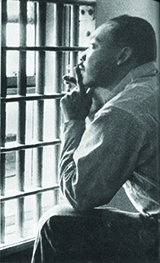
The concluding theme that emerges for me through my reflections on Dr. King's "Letter from Birmingham Jail" is his delivery to challenging the condition quo. Commonwealth is rooted in and responsive to activity. Silence and passivity have never moved a commonwealth to be concerned about the marginalized. Rather, "Injustice must be rooted out by strong, persistent, and determined action."(5)
But "strong, persistent, and determined" action takes coalition building. In his "Letter from Birmingham Jail," Dr. King highlights
all the committed individuals and institutions actively working alongside him in the Civil Rights Movement. "Letter of the alphabet from Birmingham Jail" took on new meaning for me when I rediscovered that Dr. King congratulated Spring Hill College, a Jesuit institution, for their efforts to desegregate well before other colleges and universities in the South. In fact, Spring Hill College was the merely college to desegregate for ten years in the Due south.(6)
Leap Hill College thus serves every bit an example for the active office Jesuit universities can play in fighting injustice. Spring Hill College challenged the status quo not because it was easy or popular but because it was merely. These actions showed a genuine willingness to stand in solidarity with those on the margins without concern for personal or institutional gain.
Spring Colina Higher thus serves as an instance for the agile function Jesuit universities can play in fighting injustice. Spring Hill College challenged the condition quo not because information technology was easy or popular but considering it was simply. These deportment showed a genuine willingness to stand
in solidarity with those on the margins without concern for personal or institutional gain. The leadership demonstrated past the Bound Loma College community should non be forgotten and continues to impact generations of students. I have a profound sense of gratitude that another Jesuit establishment was willing to be the first to accept that disquisitional footstep for justice.(vii)
I am equally proud of the steps my own institution, Santa Clara University, has taken to support undocumented students, both the emotional and fiscal support of the Jesuit customs, as well equally the University'due south advocacy efforts toward immigration reform. Even so, nosotros have a long way to go.
We must enquire, as a community that strives for social justice, are whatsoever of our policies or traditions adversely impacting our community members? We should consider reviewing our policy regarding domestic partners living on campus in the residence halls. If we exercise not explicitly recognize these partnerships, the quality of life for on-campus professional faculty and staff is compromised and our campus community becomes less than welcoming for the LGBTQ community.

Injustice is a disease that can infect all of us, and the only cure is 18-carat dialogue and a willingness and commitment to stand with the marginalized. Through genuine dialogue, I accept been able to unpack and examine the places
 in my life where I have oppressed others, an intense but hugely of import emotional process of exposing my vulnerabilities. Also, Dr. King's letter challenges our students, faculty, staff, administrators, and alumni to consider these questions: Did y'all seek to make a connection today with your fellow community members? Did y'all engage in genuine dialogue with someone different from yourself? Did you challenge what was unjust in the status quo?
 I hope when my daughters read this essay, they volition sympathize how much I beloved them and the work I do. I work at Santa Clara University considering I am challenged on a daily basis to be more and to do more for the students and communities we serve. We cannot be leaders in immigration rights and not exist leaders in gender equity; support for underrepresented students, and leaders in advancement for students with disabilities. More is required of us. Meeting legal requirements or measuring up to our peer institutions is not enough. Magis. More is required of me if I am going to be the role model and example my children demand. Instead of settling for the status quo, we must engage in the ever messy, ever ongoing dialogue required to course a just community.
LESTER DEANES is an Assistant Dean for Educatee Life at Santa Clara University, where he is responsible for engaging staff, faculty, and students to promote an inclusive campus community. His higher education inquiry interests are in first-year students, students of colour, and first-generation higher students.
Endnotes
- Martin Luther Male monarch Jr., "Alphabetic character from Birmingham Jail, 1963," in Martin Luther Male monarch Jr., Malcolm Ten, and the Civil Rights Struggle of the 1950s and 1960s: A Cursory History with Documents, ed. David Howard-Pitney (New York: Bedford/ St. Martin's, 2004), 75.
- Ibid.
- Come across Santa Clara University vision statement: http://www.scu.edu/jesuit/Academy-Mission.cfm
- MLK, 75.
- Ibid, 85.
- Spring Loma College, (n.d.) About SHC: History of Jump Hill College,, http://www.shc.edu/about/history-spring-hillcollege (January 16, 2013).
- MLK, 86.
hansforddecorichiggy.blogspot.com
Source: https://www.scu.edu/ic/media--publications/explore-journal/spring-2013-stories/my-reflections-on-mlks-letter-from-birmingham-jail-a-letter-to-amara-and-anissa.html
0 Response to "- Review the Structure Audience and Purpose of Kingã¢â‚¬â„¢s â€å“letter From Birmingham Jail"
Post a Comment